
Seafood Shipping Boxes: A Leakproof, Recyclable Alternative to Waxed Cardboard & Styrofoam
Sealed-edge corrugated polypropylene — 100% waterproof, 100% recyclable, made in the USA.
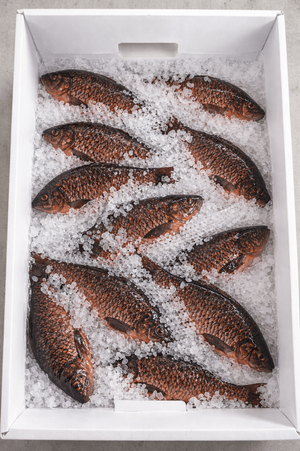
If you ship fresh or frozen seafood, the box does more work than almost anything else on the pallet. It has to hold ice melt without leaking, keep product in the cold chain, survive air freight and rough handling, and pass food-safety scrutiny — all without driving up cost or piling up in a landfill. For decades the only real options were waxed corrugated cardboard and EPS foam (Styrofoam), and each one solves a problem while creating another.
CoolSeal seafood boxes are a third option: sealed-edge corrugated polypropylene that is 100% waterproof and 100% recyclable, made in the USA at a zero-waste facility in Perrysburg, Ohio (CoolSeal USA is an Inteplast Group company). They ship flat, snap together on the line, and are a direct, drop-in replacement for the wax or foam you run today — from blast freezing to air export. This guide covers how the three packaging types compare, why leakproofing matters for air cargo and the cold chain, how to choose the right size by weight class, and what to know about food-safety certification, custom printing, and recyclability.
The Three Ways to Ship Seafood — and the Trade-offs
Most seafood processors, wholesalers, and protein distributors are choosing between three packaging families. Here is how they compare across the factors that matter on every shipment.
| Factor | Waxed Corrugated Cardboard | EPS / Styrofoam | CoolSeal Sealed-Edge Corrugated Plastic |
|---|---|---|---|
| Leakproofing | Wax breaks down when wet; seams wick and leak | Not watertight; seams and beads let liquid escape | Fully watertight — sealed flutes trap all ice melt |
| Cool-down in a cold chain | Moderate | Slow — heavy insulation holds initial field/processing heat in | Thinner walls let chill reach product faster in a controlled cold chain |
| Weight | Heavy, especially once saturated | Light but bulky | Lightweight and rigid; equal capacity in a smaller box |
| Recyclability | Wax coating makes most boxes non-recyclable | Rarely recycled; fragments into beads in the waste stream | 100% recyclable (PP5) — plastic, glues, and inks |
| Freight and storage | Low unit cost; higher freight and disposal cost | Low unit cost; high storage and disposal cost | Ships flat: ~1/7 the trucks and ~1/12 the pallet space of EPS |
| Food contact | Acceptable when intact | Risk of foam-bead contamination | Certified for direct food contact; sealed-edge hygiene |
The short version: waxed cardboard and foam each solve one problem and create another. Sealed-edge corrugated plastic is the only option that is leakproof, food-safe, fully recyclable, and freight-efficient at the same time.
Why Leakproofing Matters for Air Freight and the Cold Chain
A box that leaks is more than a mess. In air cargo it can mean rejected freight; in a blast freezer or cold room it can mean meltwater pooling against the product. CoolSeal's sealed-edge technology closes off every open flute on the board, so meltwater and ice slurry are trapped inside the box instead of running onto pallets, conveyors, and other shipments.
For air freight, carriers are strict about loose liquids and every pound of weight costs money. CoolSeal recommends a food-grade liner bag to contain the protein, plus gel packs for temperature control, packed inside the watertight box. For ground and reefer shipping the leakproof base contains meltwater on its own and removes the need for a liner; where you would rather drain meltwater in transit, the same board is offered as a drainage base. Space-conscious shippers can use pop-up boxes that fold flat to cut transport and storage cost.
There is a quality argument too. Liquid pooling at the bottom of a leaky box sits against the product and accelerates spoilage; a watertight box keeps meltwater contained and presents the catch cleanly on arrival. For exporters shipping fresh product on tight timelines, that shows up directly in grade-out, rejection rates, and repeat orders.

Insulation and Cool-Down: What an Independent Study Found
CoolSeal boxes are made from twin-wall corrugated polypropylene: thin inner and outer skins separated by corrugated flutes that form an I-beam of trapped air. That trapped air does insulate — think of the double-pane-window effect — so these are not zero-insulation boxes.
The advantage shows up inside a working cold chain. Thick EPS foam is built to insulate, which also means it traps the field heat or processing heat inside with the product. When a box is packed warm, foam slows the refrigerated air from reaching the catch; CoolSeal's thinner walls let that chill reach the product faster and pull it down to temperature.
This is backed by independent testing. The Sea Fish Industry Authority (Seafish) compared corrugated-plastic, polystyrene, and fibreboard fish boxes in Report CR192 (2002). It found the corrugated-plastic box performed comparably to polystyrene on insulation and produced an unexpected result: inside a controlled cold chain, the box let chill temperatures influence the product more effectively, adding days of shelf life. Seafish noted that where fish moves through a controlled distribution chain, a box with less insulation can be an advantage, because it lets the surrounding chill reach the product.
CoolSeal states this translates to product cooling roughly 12 hours faster than traditional polystyrene in a complete cold chain — the practical benefit for processors moving warm-packed product into chilled distribution.
Choosing the Right Size by Weight Class
Seafood ships by weight class, so the box should too. CoolSeal offers portion, fillet, and shellfish boxes across the standard ranges, plus specialty sizes. Most styles use a base-cap-lid construction that pops open on the line and stays open, with the choice of a leakproof base for wet shipping or a drainage base where meltwater should escape in transit.
| Box / Size | Internal L × W × H (in) | External L × W × H (in) |
|---|---|---|
| 5# / 3kg Portion | 14.00 × 9.25 × 2.75 | 15.38 × 9.63 × 2.88 |
| 10# / 6kg Portion | 14.00 × 9.25 × 4.25 | 15.38 × 9.63 × 4.38 |
| 20# Portion | 14.00 × 9.25 × 6.50 | 15.38 × 9.63 × 6.63 |
| 13kg Portion | 22.00 × 11.25 × 5.50 | 23.38 × 11.75 × 5.63 |
| 30# Portion | 22.00 × 11.25 × 6.75 | 23.38 × 11.75 × 6.88 |
| 10# Fillet | 22.50 × 7.50 × 3.88 | 23.88 × 8.00 × 4.00 |
| 20# Fillet | 22.50 × 7.50 × 5.13 | 23.88 × 8.00 × 5.25 |
| Salmon V2 (HOG salmon) | 29.88 × 9.00 × 7.00 | 30.50 × 9.13 × 7.13 |
| 10# Shellfish (50-count) | 14.00 × 9.25 × 4.25 | 15.38 × 9.63 × 4.38 |
| 20# Shellfish (100-count) | 14.00 × 9.25 × 6.50 | 15.38 × 9.63 × 6.63 |
| 10″ Cube / Gallon | 10.00 × 10.00 × 10.00 | 10.25 × 10.25 × 10.25 |
Matching the box to the product
• Salmon fillets
ship in the 10# and 20# Fillet boxes; whole head-on, gutted (HOG) salmon ships in the Salmon V2.
• Oysters and shellfish
ship by count: the 50-count is the 10# Shellfish box and the 100-count is the 20# Shellfish box (dimensionally the same as the matching portion boxes).
• Lobster tails
have no dedicated box, but customers ship them successfully in the 5# and 10# Portion boxes or the 13kg box.

Food-Safe and Certified for the U.S. Market
The sealed-edge construction is what makes direct food contact possible: with every flute closed off, there are no open channels for bacteria, dirt, or dust to collect, so the box is hygienic and easy to clean. The material is PP5 polypropylene — it won't absorb moisture or odors and won't fragment or shed beads the way foam can.
For U.S. buyers, CoolSeal USA guarantees that its food, drug, and cosmetic products comply with the Federal Food, Drug, and Cosmetic Act and that its facility operates under 21 CFR §123 Seafood HACCP regulations, including the requirements of Section 402 and the Bioterrorism Act. Manufacturing follows HACCP, SSOP, Sanitation Performance Standards, and GMP. No PFAS are intentionally added to the packaging, and an allergen statement confirms the products do not contain or intentionally add the major food allergens. (CoolSeal's European operations and facility are separately FSA-approved.)
A note on reuse: CoolSeal's seafood boxes are designed for single use. The board is durable and waterproof and is 100% recyclable at end of life, but CoolSeal does not publish a reuse sanitizing protocol — reuse and FDA sanitation compliance are the customer's responsibility.
Custom Printing and Branding
A shipping box is also a billboard. CoolSeal prints flexographically in UV ink directly onto the polypropylene — no laminated films are applied — so printed boxes stay 100% recyclable as PP5. You can print in any single Pantone color of your choice, and because the process is flexographic, it also handles half-tones for creative, dimensional designs.
There are no setup fees and no design or art fees; CoolSeal will design the lid with you or take print-ready artwork from your marketing team (they supply the dieline). A one-time tooling charge applies per print plate — you can pay it on the initial order or amortize it into the box cost — and CoolSeal stores the plates and replaces any damaged plate at no cost for the life of the program. Custom printing adds roughly $0.10–$0.25 per unit depending on design complexity.
Custom-printed boxes run through a MIN/MAX program with usage rates set in consultation with you; the initial run takes about 4–6 weeks from artwork approval. Because boxes ship flat and pre-folded, branded packaging doesn't cost extra warehouse space — you store far more printed boxes in the same footprint and assemble them on demand.

Recyclable, Lightweight, and Made in the USA
Every component of a CoolSeal box — the board, the glues, and the inks — is 100% recyclable PP5. Unlike waxed cardboard, whose coating usually disqualifies it from recycling, or EPS foam, which fragments into beads, CoolSeal recycles cleanly: curbside by the end consumer, or baled and sold by the wholesaler. That's part of the circular economy for polypropylene and a real reduction in disposal cost. Polypropylene is made purely of carbon and hydrogen and can be recycled or recovered without harmful emissions, which gives processors a documented answer when customers ask about eco-friendly seafood packaging.
The rigid, waterproof board is lightweight and ships flat, so it saves on freight and storage at a scale that adds up fast: one truckload of CoolSeal packaging replaces about seven truckloads of EPS, and a single pallet set of 10# Portion boxes replaces about twelve pallets of EPS — and you fit roughly 30% more product per pallet in transit. All of it is made in the USA at a zero-waste facility in Perrysburg, Ohio.
Frequently Asked Questions
What's the minimum order quantity?
Stock boxes sell in full-pallet quantities, and the minimum depends on the size's palletization — each is listed on the box's spec sheet. Custom-printed runs are quoted separately.
Can I get samples before ordering?
Yes. A sample or two typically ships free via UPS. For larger sample volumes — for example, to test palletization — CoolSeal charges only the LTL freight to your destination.
Do you print our logo on the boxes?
Yes — flexographic UV ink directly on the box, in any single Pantone color, with half-tone capability. This is popular with oyster farms and brands launching retail lines.
Are the boxes reusable?
They're designed for single use. The waterproof polypropylene board is durable and won't break down when wet, and it's 100% recyclable at end of life, but CoolSeal doesn't publish a reuse sanitizing protocol, so reuse and FDA sanitation are the customer's call.
What sizes do you have for oysters, lobster tails, and salmon fillets?
Oysters and shellfish ship by count — 50-count (10# Shellfish) and 100-count (20# Shellfish). Salmon fillets ship in 10# and 20# Fillet boxes; whole HOG salmon in the Salmon V2. Lobster tails have no dedicated box but ship well in the 5# or 10# Portion boxes or the 13kg box. Custom sizes are available.
Are they FDA / direct-food-contact safe?
Yes. CoolSeal USA guarantees compliance with the Federal Food, Drug, and Cosmetic Act and operates under 21 CFR §123 Seafood HACCP. The material is PP5 polypropylene with no intentionally added PFAS, backed by an allergen-free statement.
Can they handle blast freezing or IQF?
Customers successfully block-freeze (for example, shrimp in the 5# Portion box) and run IQF value-added products in CoolSeal boxes. There is no published low-temperature rating; as with any polypropylene, the material becomes more brittle as it gets colder, so handle with care to avoid impact cracking at blast-freeze temperatures.
How do they compare to waxed boxes and Styrofoam on cost?
Unit cost is competitive, and total landed cost is usually lower: boxes ship flat (about an 85% cut in trucks and storage space versus EPS), weigh less in freight, and recycle rather than becoming a disposal expense.
Ready To Switch From Waxed Cardboard Or Styrofoam?
Get a quote on stock or custom-printed seafood boxes — or order samples to test against your current packaging